


BI Kept Rates Steady at 4.75%
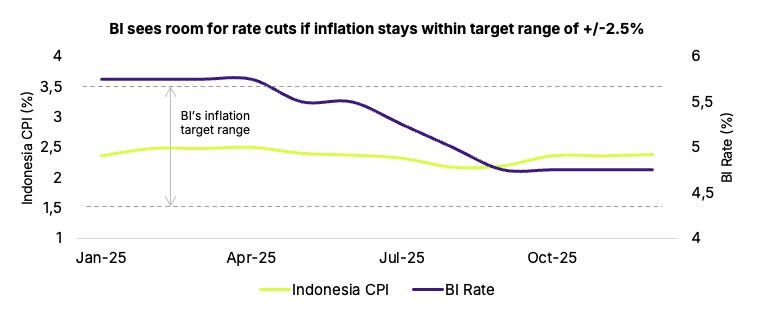
Last Wednesday, Bank Indonesia (BI) continued to keep interest rates unchanged at 4.75%, again reiterating their stance to prioritize Rupiah stability amid rising geopolitical uncertainty, with the USD/IDR reaching a low of ~16,910 on January 20th.
During a press conference, Governor Perry Warjiyo stated that BI will continue to strengthen the transmission of monetary and macroprudential easing already in place, and sees room for rate cuts in 2026 if inflation stays within the target range of around 2.5%.
JCI Fell -1.36% from Profit-Taking
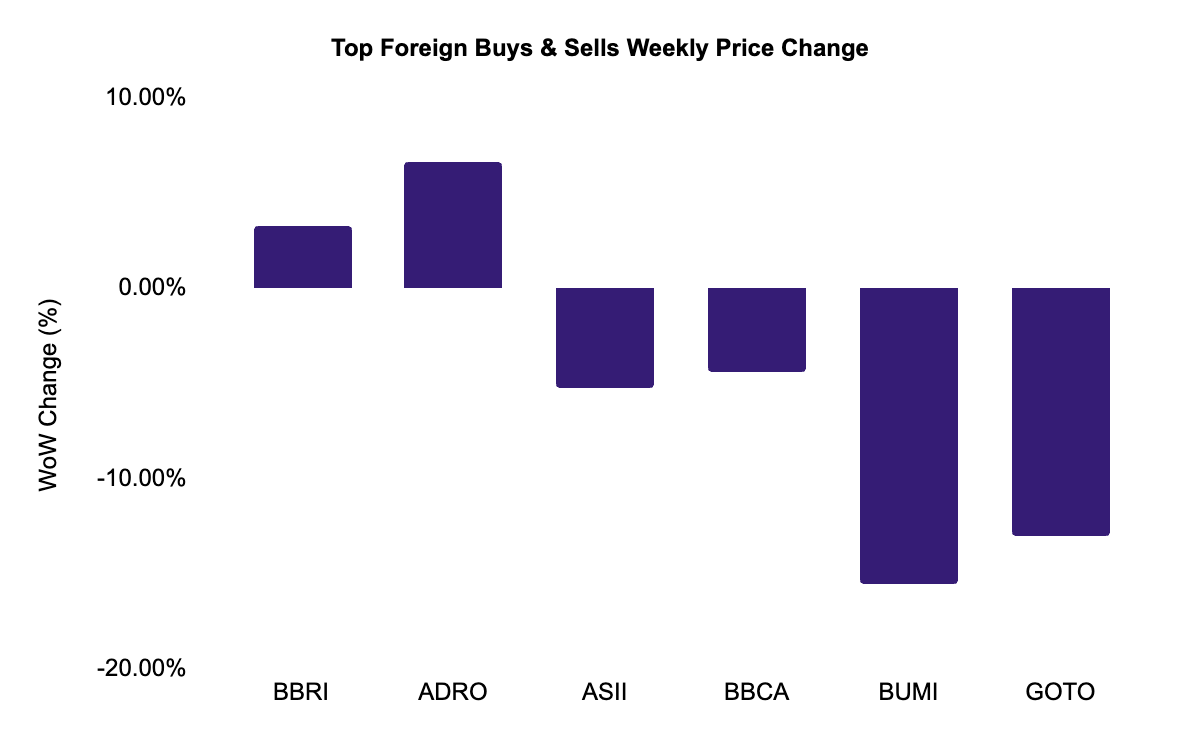
Although the decision was in-line with market expectations, the JCI saw pressure and dropped -1.36% last week after reaching an all-time high of ~9,164. There were no main headline reasons; rather, pressure was driven by profit-taking especially with some investors resetting expectations ahead of the MSCI rebalancing which will take place on February.
The sell-off was broad based across momentum stocks and blue-chip stocks, with the IDX30 blue-chip index dropping almost 1%. Foreign investors were net sellers of IDR ~3.5T, while domestic investors absorbed supply. Top foreign sells were BBCA, BUMI, and GOTO, while top foreign buys were BBRI, ADRO, and AASI.
Gold & Silver Continue to Reach New Highs
Geopolitical tensions continued to persist last week, with President Donald Trump threatening 100% tariffs on Canada and European countries if they do not agree to a deal regarding U.S.’ plans to invade Greenland. This sparked fears of a global trade war, and amid rising geopolitical tensions, investors continued to rotate into safe-haven assets.
The DXY (U.S. Dollar index) fell almost -1.67% and closed at 97.48 on Friday, making dollar-priced metals like gold and silver more attractive to foreign buyers. Gold (XAU/USD) reached a new high of USD $5,111/oz, while silver (XAG/USD) also reached a new high of USD $110/oz.
Click here to read more about how Simpan is positioned.
China PMI Outlook
We are closely monitoring China’s official manufacturing PMI number, which will be released on January 31st. For context, PMI (Purchasing Managers’ Index) is a monthly economic indicator tracking manufacturing/services health. A PMI number of above 50 suggests that the economy is expanding, while a number of below 50 suggests that the economy is contracting. December 2025 number was 50.1, but in 2026, questions remain on whether manufacturing can sustain this momentum amidst ongoing structural headwinds in the property sector and weak domestic consumption.
As one of Indonesia’s largest trading partners, China’s PMI is an important signal for Indonesia’s import–export outlook. An expansionary PMI (>50) suggests rising factory output and stronger demand, which typically supports Indonesia’s exports, particularly commodities such as coal, nickel, and palm oil. Conversely, a contractionary PMI could weigh on export demand and may add pressure on the rupiah through weaker trade dynamics.