

For the past month, we have been cautious on Indonesian equities. MSCI’s proposal to downgrade Indonesia to Standalone status landed on a market that had already lost a third of its value this year, and foreign investors sold heavily in the weeks that followed. The backdrop is still difficult, and the story is not over. But a month on, the pressure on the market is easing, and the risk that remains is one we can now put a size on.
Where Things Stood Before the Consultation
Indonesia’s equity market was having a hard year well before October. The IHSG peaked at 9,134.70 on 20 January, about a week before MSCI froze changes to Indonesia’s index over concerns about free float, opaque ownership and suspected coordinated trading. By 15 October it had fallen to 5,863.78, down 32.19% for the year, and foreign investors had sold a net Rp 84.81 trillion, about USD 4.88 billion, of Indonesian stocks. By MSCI’s own count, Indonesia’s weight in its Emerging Markets Index shrank from 1.16% at the start of the year to 0.43% by the end of September.
Regulators had already started to respond, raising the minimum free float to 15%, requiring disclosure of shareholders above 1%, and flagging stocks whose ownership is highly concentrated. MSCI judged that this had not yet produced results it could measure. On 15 October it opened a consultation on moving Indonesia from Emerging to Standalone status, and the IHSG fell 11.57% the next day, its worst session since January 1998. Foreign investors sold another Rp 13.05 trillion over the rest of October, and the index touched its low for the year, 4,904.29, on 3 November.
What Has Changed Since
Two things have moved in Indonesia’s favor since then, one abroad and one at home.
The first is oil. Democrats won both chambers of the US Congress on 3 November, which markets read as pressure on the White House to find a way out of the Iran war. Brent crude fell to USD 92.57 a barrel on 9 November, its lowest since late August, after President Trump said new strikes on Iran were highly unlikely while talks progressed. It ended that week at USD 95.84, down from about USD 113 at the end of October. Indonesia imports more oil than it exports and has frozen subsidized fuel prices until the end of the year, so cheaper oil eases the strain on both the budget and the rupiah. Oil is still well above the price the budget assumed, but the direction has turned.
The second is reform, and this time it comes with enforcement. On 2 November, 81 stocks with highly concentrated ownership were taken out of the IHSG, so the index better reflects shares that investors can actually buy. Since 4 November, the exchange’s monthly list of shareholders above 1% also shows who controls them and whether they are affiliated. In October, OJK fined parties in the DSSA, BREN and CUAN cases a total of Rp 2.1 trillion and handed over the sanction letters with the national police present. On 16 November, OJK investigators went a step further and detained three suspects in a case of alleged manipulation of warrant trading. The case is small and the suspects have not been tried, but the signal is larger. Manipulating Indonesian securities now carries a real risk of detention, which is the kind of enforcement MSCI said it had not yet seen.
The Overhang Is Shrinking
The best evidence that the selling is fading is in the flows.
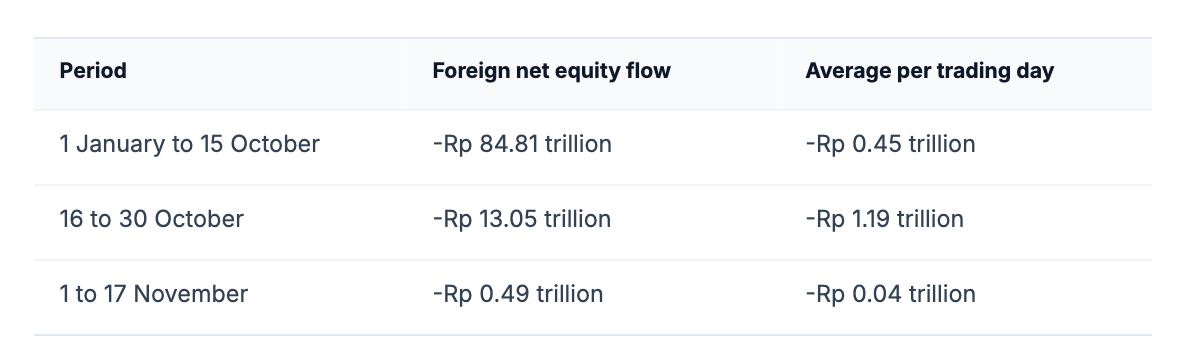
Foreign selling peaked in the two weeks after MSCI’s announcement, at more than Rp 1 trillion a day, including Rp 3.33 trillion on 16 October alone. In November it has slowed to a trickle, with no session above Rp 0.6 trillion either way. Meanwhile the IHSG has climbed 8.17% from its 3 November low to 5,304.76 on 17 November, with little help from foreign money. A market that can rise while its largest seller of the year steps back suggests that much of the forced selling has already happened.
The index arithmetic points the same way. MSCI’s November review removes Barito Pacific (BRPT) from its indexes and moves Bumi Resources Minerals (BRMS) down to Small Cap from 30 November. After that, Indonesia’s weight in the MSCI Emerging Markets Index is around 0.4%, about a third of where it began the year. Estimates put the passive selling from a full move to Standalone at about USD 3.6 billion. That is less than the USD 5.6 billion foreign investors have already sold this year, and about three to four weeks of normal trading in the large banks that make up most of it. The forced selling still ahead is a known and manageable amount. Judging by the flows, much of a Standalone outcome is already in the price.
That matters for what comes next. Whichever way MSCI decides by June 2027, a settled answer removes the uncertainty that has kept many investors out. Those who have held back for clarity, including active funds not tied to MSCI and funds benchmarked to FTSE Russell, which has kept Indonesia in its Emerging Markets index, will be able to buy at prices that already reflect a great deal of bad news. At home, Danantara has said it sees the correction as a chance to add to fundamentally strong state-owned companies.
Outlook and Implications
This is not the end of the story. The 30 November rebalance will bring another round of passive selling in the stocks MSCI removed, and the Standalone decision is not due until June 2027. If it does come, active funds benchmarked to MSCI could sell on top of the passive estimate, and that is the larger unknown. The Fed also looks set to raise rates again in December, which keeps the rupiah under pressure. At home, political uncertainty has not gone away. The President’s call on 14 November for the state to take at least 70% from every mining permit, with no rule yet saying 70% of what, is a reminder that trust in the market still has to be rebuilt.
Still, the direction has changed. Selling pressure is fading, reform now comes with enforcement, and cheaper oil is helping the budget. The IHSG trades at about 8 times forward earnings, around three standard deviations below its historical average, while the economy grew 5.47% in the third quarter and earnings are still expected to grow close to 10% next year. We understand that times are tough, and good news is hard to see when political uncertainty and doubts about the market’s integrity fill the headlines. But the pressure on the IHSG is slowly lifting as the Standalone decision draws closer, and if the index drifts lower from here, we would see further falls as a better entry point rather than a new warning. Stay the course if you are already invested, and consider this weakness an opportunity to add.