

Half of Jakarta spent three hours watching Odysseus take the long way home, and it’s hard not to notice the parallel sitting in our own portfolios. Indonesia’s markets have spent the first half of 2026 on a fairly Odyssean detour of their own: storms nobody fully priced in, a few sirens singing “sell everything,” and a homecoming that keeps getting pushed back a chapter.
We’re not going to stretch the metaphor further than it deserves. But if there’s one thing the myth gets right, it’s this: the journey being long doesn’t mean it’s going nowhere. Ithaca was still there the whole time.
1H 2026 tested Indonesia’s resilience directly. The fiscal deficit widened faster than budgeted, MSCI opened a formal review of the market’s accessibility, and an unprecedented US-Israel conflict with Iran sent oil sharply higher in February. Against that backdrop, the IHSG fell roughly 30% year to date, foreign investors kept exiting both equities and bonds, and Bank Indonesia hiked rates to defend a weakening Rupiah rather than cut to support growth. The US told a different story entirely, with the S&P 500 climbing to fresh record highs.
Policy is pulling in two directions
Indonesia’s 2026 budget targeted a deficit of -2.48% of GDP. First-half spending alone reached -0.76%, and we expect that to accelerate into the second half. Consensus now sits at -2.8% to -2.9%, uncomfortably close to the -3% legal ceiling the country hasn’t approached outside the Covid era. At the same time, Bank Indonesia has hiked 100 basis points to defend the currency, even as the government has channeled roughly Rp400 trillion of liquidity into Himbara banks to cheapen the cost of lending. Fiscal and monetary policy are, for the first time in a while, not pulling in the same direction.
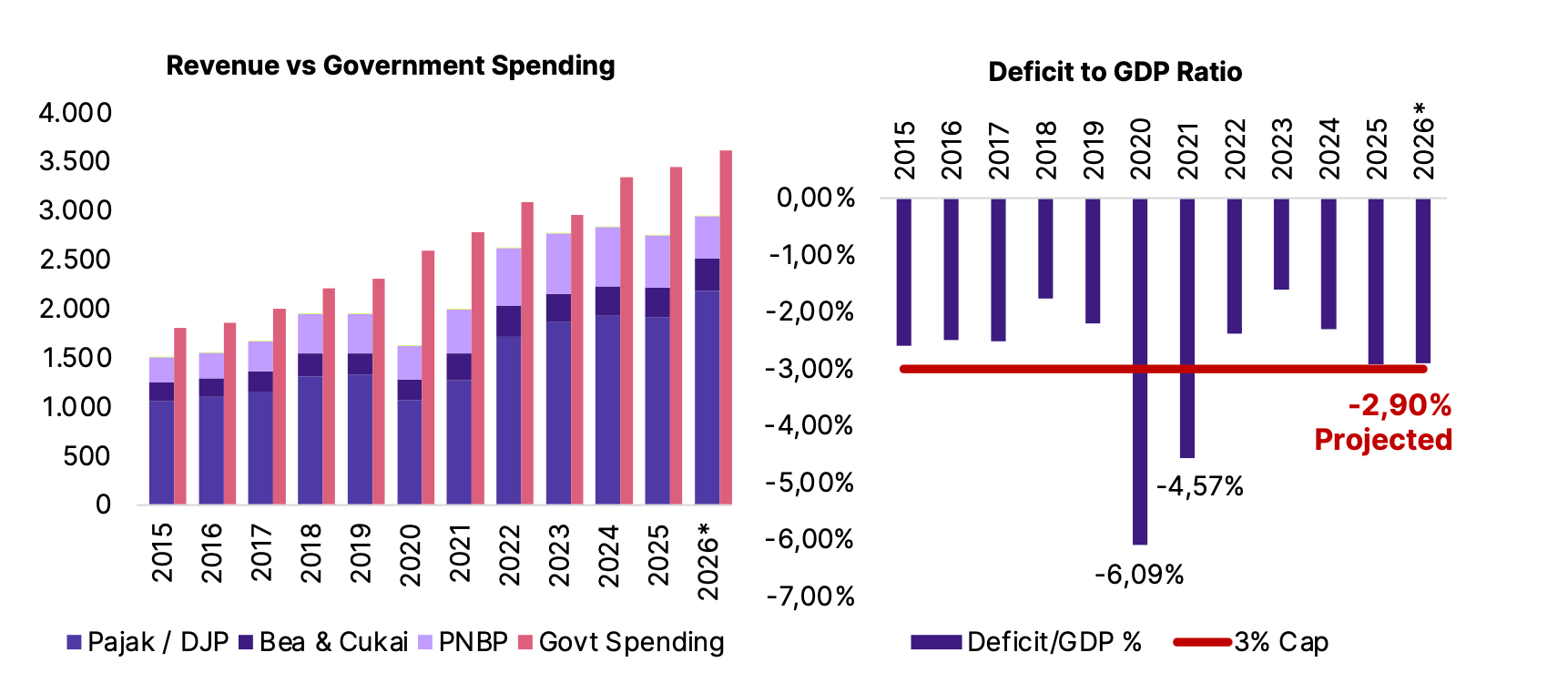
Danantara and DSI add another layer of uncertainty. Both institutions are chasing legitimate goals, faster capital deployment and closing the export under-invoicing gap, but neither has built the transparency to match its ambition yet. No annual report has come out of Danantara since its February 2025 launch, despite roughly USD 1 trillion in assets under its umbrella.
The world is watching two verdicts
Indonesia is being reassessed on two related tracks this year, and both come down to the same underlying question: does the market believe Indonesia’s policy commitments.
MSCI opened a formal accessibility review in January, and at its June Annual Review, it kept Indonesia’s Emerging Market status but flagged a possible Frontier Market reclassification if “adequate progress” isn’t shown by November. Indonesia has responded with real reforms: the minimum free float requirement rose from 7.5% to 15%, ownership disclosure now extends to the ultimate beneficial owner for stakes under 5%, and shareholder sub-type categories expanded from 9 to 27. We believe these reforms directly address what MSCI flagged, and we don’t expect a downgrade. But November is a hard deadline, and the market will price the uncertainty until then.
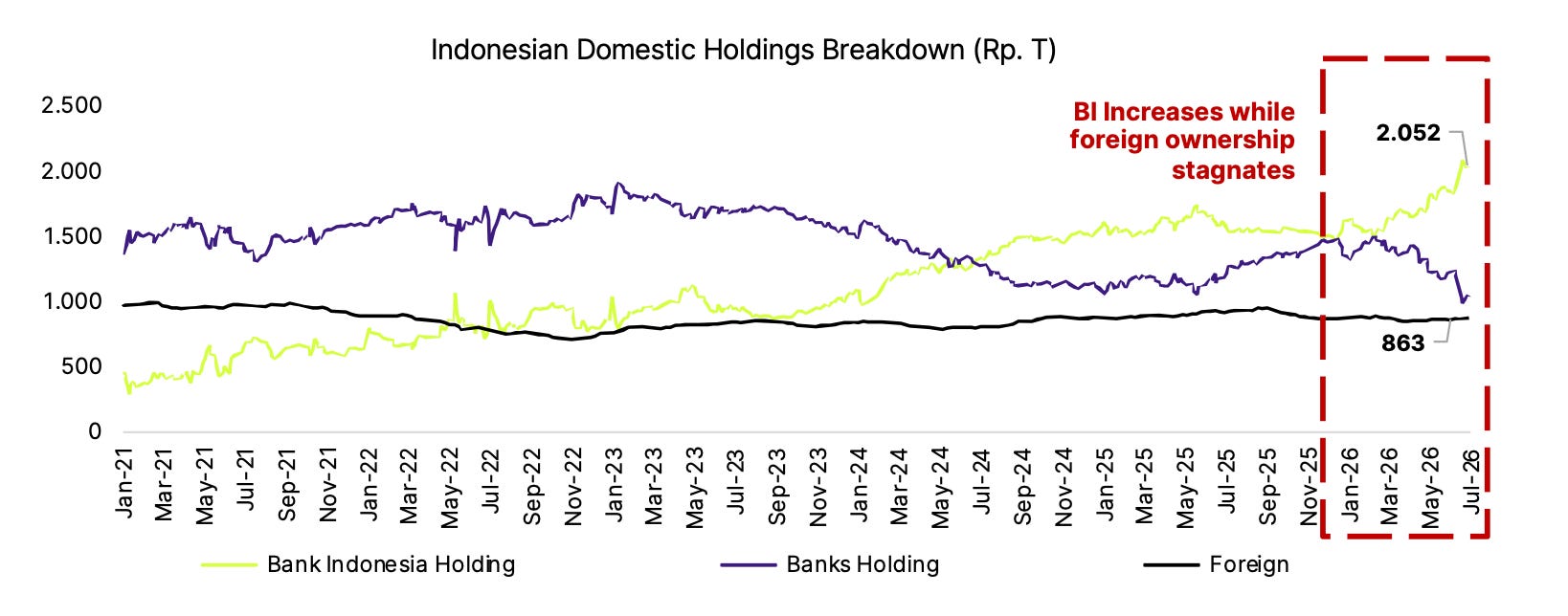
On credit, Moody’s and Fitch have already cut Indonesia’s outlook to Negative, citing policy unpredictability. S&P is the outlier, holding a stable outlook that reflects growing confidence the deficit ceiling will hold. That confidence is conditional. If fiscal discipline slips, the rating story could shift quickly.
A valuation gap that looks temporary
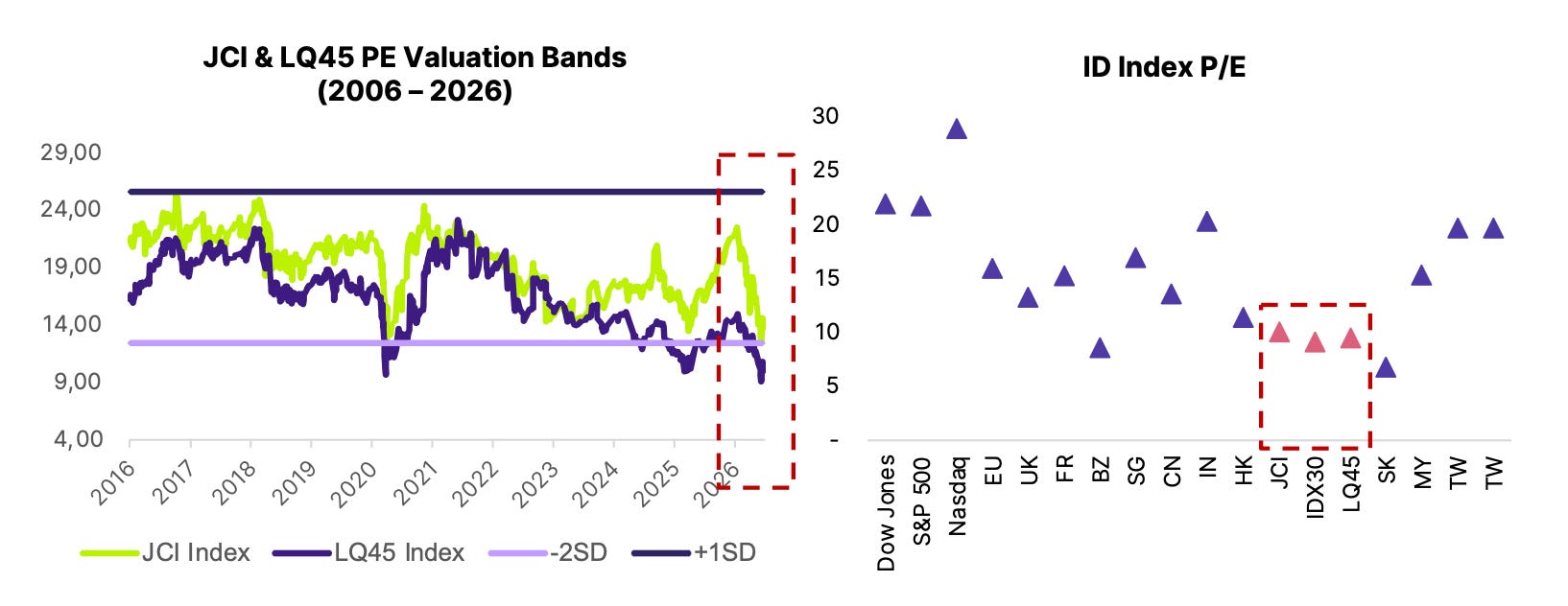
Here’s where it gets interesting. The IHSG is trading near 13x trailing earnings, more than two standard deviations below its 20-year average, a discount last seen in 2008 and 2020. When we decompose the decline, it’s come almost entirely from multiple compression rather than earnings downgrades. Value and Quality factors have been rewarded even as Growth and sentiment factors fell sharply, which tells us this is a sentiment and flows story, not an earnings one.
Real bond yields tell a similar story. At 3.9 to 4.3%, they’re among the widest since 2010, and Indonesia remains the only ASEAN-4 market still paying a positive 10-year yield spread over US Treasuries. Fixed income investors are, in effect, being compensated to wait out the stabilization.
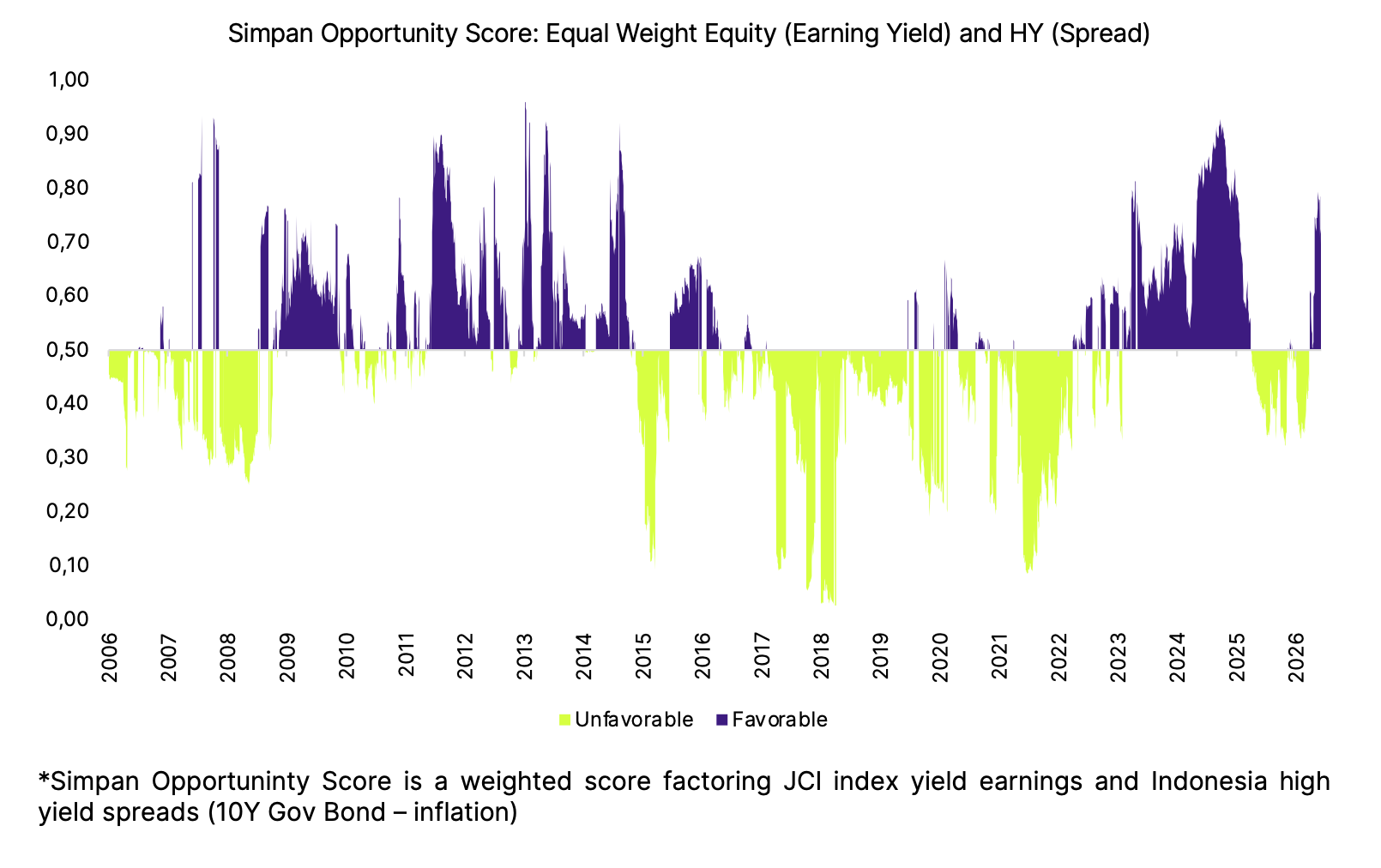
Our Simpan Opportunity Score, which averages percentile ranks for equity earnings yield and real bond yields across 20 years of data, currently sits at 0.79. That’s an 87th percentile reading on equities and 71st on bonds, together placing current conditions in the top quintile of the score’s history. We’ve seen readings like this during the 2008 financial crisis, the 2013 taper tantrum, and the 2020 drawdown. In each case, equities re-rated once the acute stress passed. This isn’t a timing signal, but it is a reminder that price still matters, especially when the story feels uncertain.
The global backdrop isn’t making it easier
Jerome Powell’s departure and Kevin Warsh’s arrival at the Fed initially read as dovish to markets. We think it’s closer to continuity. Warsh inherits an economy with a resilient labor market and inflation that remains stubbornly above target, leaving little room for aggressive cuts. Markets are now pricing a long-run neutral rate closer to 3.5 to 4.0%, above the Fed’s own 3.0% estimate, which keeps US yields and the Dollar elevated and pressures the Rupiah in turn. The currency has already moved from around IDR 16,600 to nearly IDR 18,000 against the Dollar this year.
Layered on top of that is the Iran conflict, which the IEA now characterizes as the largest energy supply disruption in history. Energy shocks are unusual in that they’re simultaneously recessionary and inflationary, and we’re now seeing the second-round effects: higher freight and manufacturing costs bleeding into core inflation, complicating rate-cut paths everywhere. Gold has been the clearest beneficiary, thriving on the combination of geopolitical fear, sticky inflation, and central bank buying.
Where that leaves us
Indonesian risk assets are cheap for reasons that look real but reversible. The equity de-rating reflects sentiment and flows rather than a genuine earnings problem, and bonds are paying close to 4% in real terms while investors wait for clarity. As long as the sovereign rating holds, we think valuations and relative price are sitting at an attractive entry point, for investors who can be patient through the next few months of policy noise.
As a fund house that believes in building more resilient portfolios, we don’t believe in concentrating solely in IDR assets. While IDR assets look attractive, we see real value in diversifying into non-IDR assets, such as dollar-denominated instruments.
This is a condensed version of our full 2H26 Macro Outlook, which includes our complete macro dashboard, detailed charts, and a full recap of how our 2026 calls have played out so far: