

Why Investors Should Pay Attention
On 19 November 2026, Indonesia’s parliament (DPR) passed the Asset Forfeiture Law, allowing the state to seize money and property linked to certain crimes through the courts, even without first obtaining a criminal conviction against the owner.
On paper, this is a positive step towards stronger law enforcement and asset recovery. But for investors, the bigger question is how these new powers will be exercised.
The law arrives amid a broader shift towards greater state involvement in private businesses, particularly in strategic sectors such as mining, palm oil and exports.
This creates three areas worth watching:
Corporate risk: Businesses dependent on government permits, concessions and export regulations could face greater uncertainty.
Market risk: Concerns over enforcement could weigh on investor confidence, particularly in resource-related companies.
Portfolio risk: Greater regulatory uncertainty reinforces the importance of assessing company-level exposure and managing sector concentration.
The law may ultimately strengthen Indonesia’s institutions. But until its implementation becomes clearer, investors will need to account for the possibility of greater political and regulatory uncertainty.
What the Law Actually Allows
The bill addresses a long-standing problem: corruption cases can end with prison sentences while much of the stolen wealth remains unrecovered. Suspects who flee abroad, die or conceal assets under other people’s names can leave the state unable to recover the proceeds.
First drafted in 2008, the bill remained dormant for 15 years before President Jokowi submitted it to parliament in 2023. It stalled again until public pressure following the August 2025 protests brought the issue back into focus. Fifteen months later, all political parties voted in favour.
The law is designed to target the proceeds of crime rather than relying solely on criminal convictions.
Key provisions
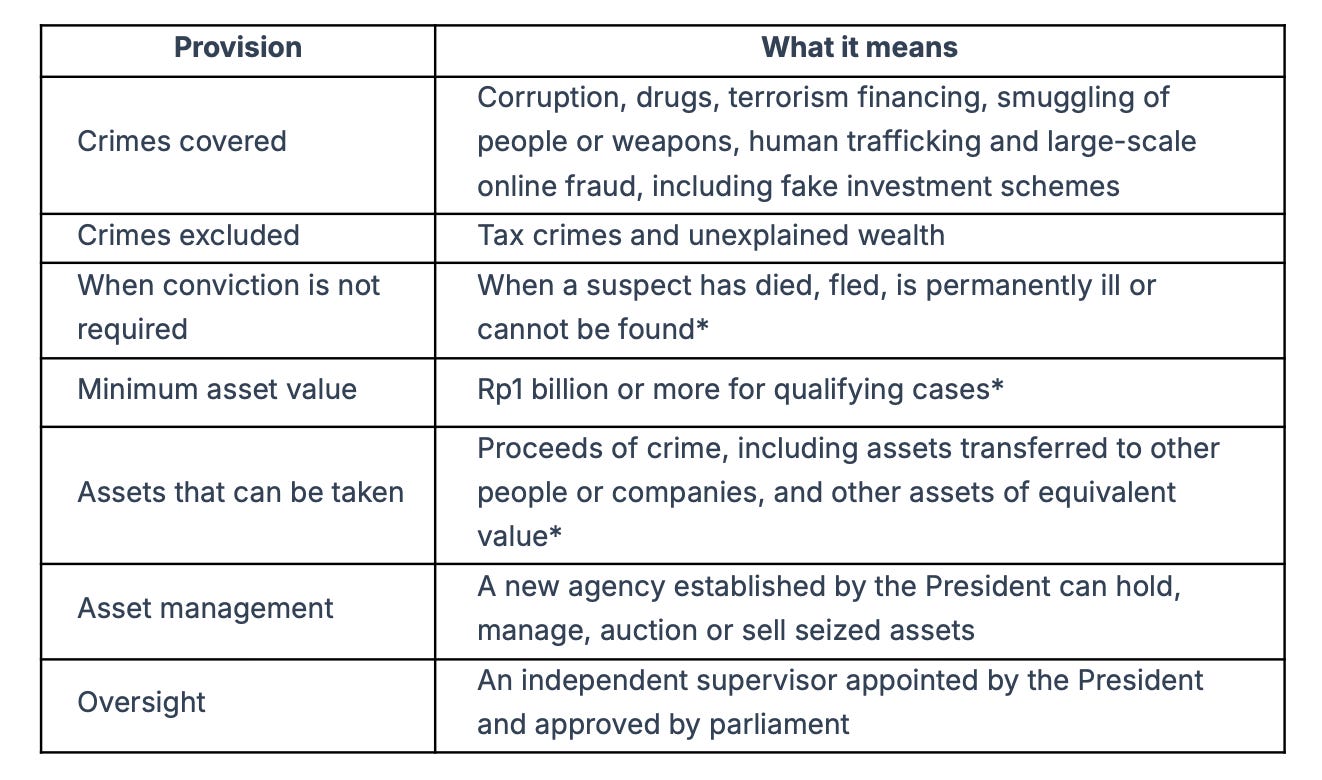
The process involves investigators tracing and freezing assets first, followed by court proceedings to determine whether the state can permanently take them. A final court ruling is required for forfeiture.
Two aspects deserve particular attention. The exclusion of tax crimes and unexplained wealth narrows the law’s scope, as authorities must still establish a link between assets and one of the listed crimes. However, assets can be frozen before a final ruling, creating potential pressure on owners and businesses even before the legal process concludes.
The law takes effect once signed by the President, or automatically 30 days after its parliamentary passage.
Why the Timing Matters: A Broader Pattern of State Intervention
The law would be easier to assess in isolation. But investors are likely to interpret it alongside a series of developments that have increased the state’s role in private businesses since mid-2025.
These developments do not establish a coordinated effort to take over private companies. However, together they shape how investors perceive the government’s relationship with the private sector.
A timeline of developments
August 2025: Indonesia’s wealthiest families were pressed to purchase government-issued Patriot bonds at below-market rates. After the Hartono family, which controls BCA, sent only a representative, a coalition party called for the state to take back BCA. A family member was later briefly held in a tax investigation.
2025 onward: The government seized millions of hectares of privately operated palm oil plantations.
May 2026: Coal, palm oil and ferro-alloy exports were ordered to be channelled through a single state-owned company, with the arrangement set to apply fully from 2027.
October 2026: Bayan’s founder sold approximately 30% of the coal miner to Haji Isam, a businessman with close ties to the President. The transaction came amid concerns about export quotas, which Moody’s had previously flagged. Bayan’s founder described the sale as purely commercial, and there is no public evidence of pressure.
November 2026: Prabowo told ministers that at least 70% of the benefits from mining permits should accrue to the state, including through taking shares if necessary. Two days later, parliament passed the Asset Forfeiture Law.
The political backdrop adds another layer. Vice President Gibran resigned on 12 November, citing personal reasons, following controversy over his high-school diploma. His replacement is scheduled to be chosen on 9 December.
Nothing officially links these events. But a leadership change, a push for greater state participation in mining and a new asset seizure power all emerged within eight days.
For investors, the concern is not necessarily any single policy. It is the accumulation of government interventions and what they could signal about the future operating environment for private businesses.
Where the Real Risk Lies: The Freeze Before the Final Ruling
The law’s objective is understandable. Recovering assets from individuals who flee abroad, die or conceal wealth is a legitimate anti-corruption goal.
The concern is whether these powers could be applied selectively, particularly against business owners or political opponents. Three features make this worth monitoring.
1. An asset freeze can become leverage
Assets can be frozen before a final court ruling. For a business owner, having bank accounts, shares or other assets frozen can disrupt operations and create pressure to settle or sell, even if the case has not been resolved.
2. The interpretation of corruption matters
A corruption case does not always require evidence that an individual personally received a bribe. A court can find state financial losses arising from a policy or administrative decision.
Consider former trade minister Tom Lembong, who was sentenced to 4.5 years in prison in July 2025 over sugar import permits. The judges found no evidence that he personally received money. The alleged state loss of Rp194 billion was based on revenue that a state-owned company could have earned but did not. Prabowo cancelled the case two weeks later.
The case illustrates why the interpretation of state losses matters. Business and policy decisions can become subject to corruption proceedings, even without evidence of personal enrichment.
This does not mean ordinary business decisions will automatically become grounds for asset seizure. However, it reinforces the importance of clear legal standards and safeguards.
3. Oversight depends on presidential appointments
The President chooses both the agency responsible for managing seized assets and the independent supervisor tasked with overseeing the process. Although parliament must approve the supervisor, the appointment structure raises questions about how independent the oversight will be in practice.
Ultimately, the law’s credibility will depend not only on its provisions but also on the independence and transparency of the institutions responsible for enforcing it.
What This Means for Indonesian Markets and Your Portfolio
We see this development as another reason to be selective in Indonesia’s equity market.
Resource-related companies could face greater pressure as investors reassess regulatory exposure, earnings visibility and valuations. Continued uncertainty could also weigh on foreign investor confidence and keep government bond risk premiums elevated.
From a portfolio management perspective, we focus on:
Company exposure: Assessing businesses heavily dependent on government permits, concessions and export policies.
Concentration risk: Understanding how much portfolio risk is tied to similar sectors or policy developments.
Diversification: Maintaining exposure across sectors, asset classes and currencies.
We don’t believe every policy development warrants an immediate portfolio adjustment. What matters is whether it changes an investment’s underlying fundamentals or risk-reward profile.
What to Watch
Four developments will help determine whether the law strengthens governance or becomes another source of uncertainty for private investors:
Published legal text: How long assets can remain frozen, what evidence is required and how owners can appeal.
Key appointments: Whether the asset management agency and independent supervisor demonstrate institutional independence.
Early enforcement cases: Whether the first cases focus on clear criminal proceeds, such as fugitives and drug money, or extend to businesses and political figures.
Asset disposals: Whether seized assets are sold through transparent public auctions or direct transactions.
Our View: Better Governance Requires Predictable Enforcement
The law has a legitimate purpose, but its credibility will depend on transparent enforcement, independent oversight and consistent legal safeguards.
In the near term, we expect political and regulatory uncertainty to weigh on investor confidence, particularly in resource-related equities, while keeping bond risk premiums elevated.
Over the longer term, fair and consistent enforcement could strengthen governance and support market confidence.
Our approach is to distinguish short-term market sentiment from changes in investment fundamentals. We will continue monitoring policy developments, assessing company-level risks and maintaining portfolio diversification rather than reacting to political headlines alone.