

Going into the US midterm elections, we were already cautious on Indonesian equities. The MSCI review was still hanging over the market, foreign investors were still selling, and for November we had cut the equity weight in AMP Tier 5, our most growth-oriented portfolio, to 35.00% from 70.00%. The result has not changed that view, but it has changed some of the backdrop.
On 3 November, American voters handed the Democratic Party control of both the Senate and the House of Representatives. Wall Street rallied on the first day, with the Dow posting its best session since April 2025, and oil fell 8.7%. A day later, AI stocks sold off and dragged the S&P 500 down 4.4%. Back home, the IHSG closed 2.25% higher on 5 November. We see this as a small win for Indonesia, but the issues holding our market back are domestic, and a change in Washington does not fix them.
What the Midterms Changed
The midterms are held halfway through a president’s four-year term, when every House seat and about a third of the Senate go up for election. Congress writes the country’s laws and controls federal spending, and a bill has to pass both chambers before it reaches the president.
For the past two years, Republicans controlled both chambers, including a 53-47 majority in the Senate. They passed Trump’s 2025 tax law, which the Congressional Budget Office estimates will add about USD 3.4 trillion to deficits over ten years, and largely left tariffs and the war with Iran to the White House.
The swing was bigger than most forecasts earlier in the year. Democrats needed four more Senate seats to take control and are projected to have won at least seven. Roy Cooper became the first Democrat to win a Senate seat in North Carolina since 2008, and in Texas, James Talarico ended a 32-year Republican winning streak in statewide races.
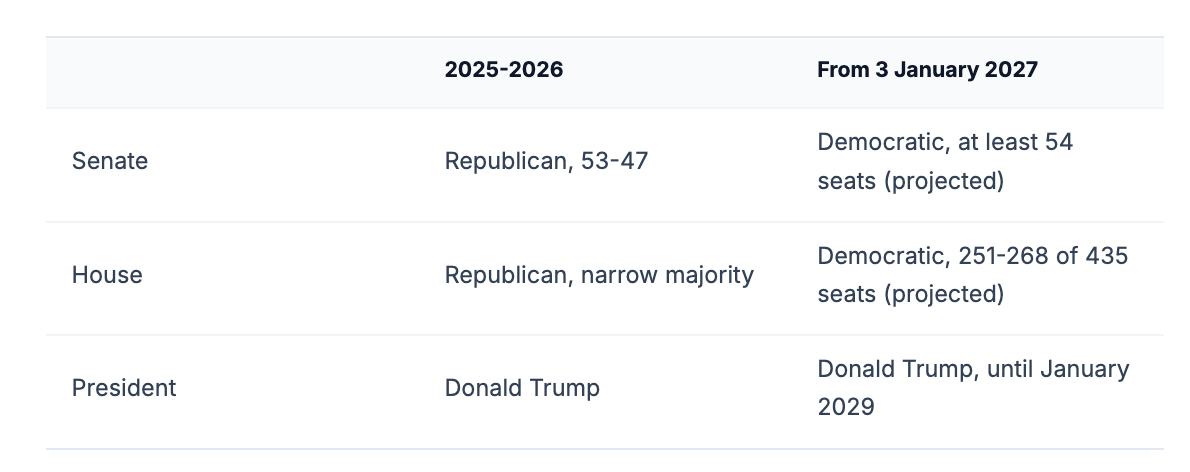
Still, a majority in Congress is not the same as control of Washington. Trump can veto any bill Congress sends him, and overriding a veto takes two-thirds of both chambers, or 67 of 100 senators. Democrats are well short of that, so the realistic outcome is gridlock. They can block new Trump policies, hold back funding for the Iran war, open investigations and stall his nominees, but they cannot undo existing laws on their own.
How Markets Reacted
With Democrats running Congress, another round of tax cuts paid for with borrowing looks unlikely, so investors bought Treasuries and pushed the 10-year yield to its lowest level in nearly two months. Gold rose more than 3% on 4 November as the dollar weakened.
Brent oil dropped to USD 94.62 a barrel as traders bet the result would push the White House to find a way out of the Iran conflict. Congress cannot end the war by itself, so this is a bet on diplomacy rather than on more supply.
The sharpest move came in tech. Nvidia fell 9.2% on 5 November on worries that Democrats, especially at the state level, will slow the data-center build-out that AI depends on. Texas, home to about 30% of planned US capacity, has just elected a governor who backs a moratorium on new data centers. With AI-linked stocks making up close to half of the S&P 500 by one estimate, an already nervous trade got one more thing to worry about.
What It Means for Indonesia
For Indonesia, the clearest benefit is cheaper oil. We import more oil than we export, and with subsidized fuel prices frozen until the end of 2026, higher oil prices land on the state budget. Indonesia’s crude price averaged USD 92 a barrel from January to October, well above the USD 70 assumed in the budget, so any decline helps. The rupiah strengthened 0.47% on 5 November.
That said, we should not overstate it. Oil is still well above the budget assumption, so the subsidy bill gets lighter but does not go away, and programs such as Makan Bergizi Gratis and Koperasi Desa Merah Putih will keep the budget under pressure regardless. It is also telling that while US Treasury yields fell, Indonesia’s 10-year government bond yield rose to 7.74% on 5 November.
Day after the midterm, the equity rally also came on thin turnover of Rp 9.81 trillion, well below October’s daily average of about Rp 16 trillion, and foreign investors were net sellers on the day. Part of the lift came from third-quarter GDP growth of 5.47%, released the same day. Much of the rest came from gold-mining stocks riding the gold price, which looks more like short-term trading than investors coming back to Indonesia. The IHSG is still down 41.83% this year.
Where This Leaves Us
We remain cautious, because the make-or-break for Indonesian assets is what happens at home. MSCI is still consulting on whether to move Indonesia from Emerging to Standalone status, with feedback open until 30 April 2027 and a final decision due by 30 June 2027. On top of that, there is the political uncertainty that came with a new central bank governor, a new finance minister and a cabinet reshuffle in the past few months.
Until we see a steadier backdrop at home, our positioning stays defensive, and we are not reading too much into one strong day for the IHSG. Whatever relief Washington offers, whether Indonesia recovers will be decided in Jakarta.